
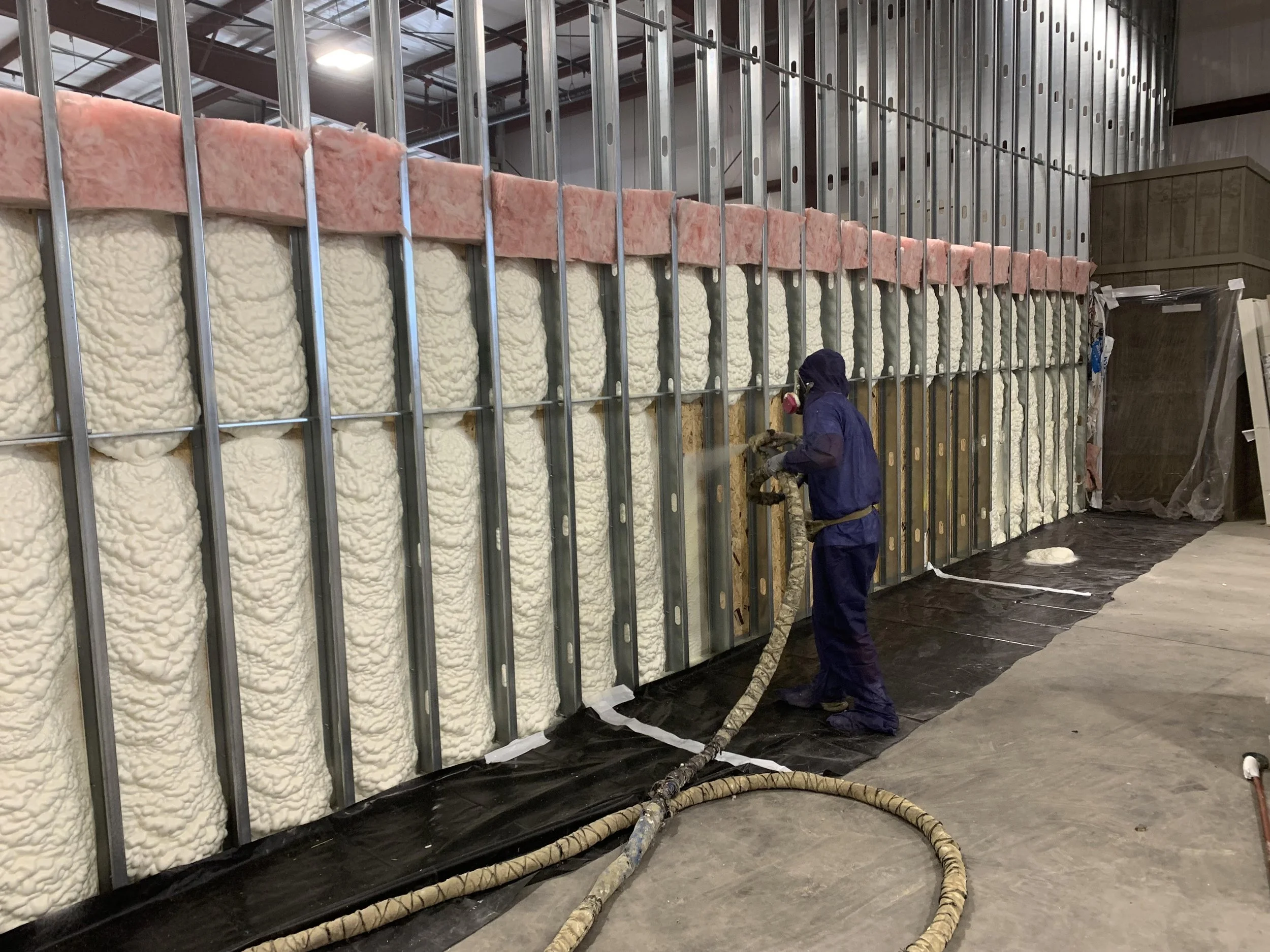
Commercial Spray Foam Insulation in Murfreesboro, TN
High-Performance Insulation for Commercial Buildings and New Construction
Complete Insulation provides commercial spray foam insulation for general contractors, developers, property managers and business owners throughout Murfreesboro, Rutherford County and Middle Tennessee.
We install open-cell and closed-cell spray polyurethane foam in new construction, renovations, tenant improvements and existing-building retrofits. Spray foam can provide thermal insulation and air-barrier performance in a single application when installed at the appropriate thickness.
According to the U.S. Department of Energy, walls, roofs and windows account for approximately 30% of the primary energy consumed in commercial buildings. Improving the building envelope can help control heat transfer, air leakage and operating costs.
What Is Commercial Spray Foam Insulation?
Spray polyurethane foam is a two-component material applied as a liquid to approved surfaces. It expands and cures to form a continuous insulation layer that adheres to framing, sheathing, concrete, masonry and metal when compatible with the selected product.
At manufacturer-specified thicknesses, spray foam can:
Resist heat flow
Reduce uncontrolled air leakage
Fill irregular cavities
Seal around penetrations
Support moisture-control strategies
Reduce some sound transmission
Provide high R-value in limited space
Create continuous coverage across complex surfaces
Commercial spray foam is used in new buildings and retrofits where energy performance, air sealing or difficult building geometry makes conventional insulation challenging.
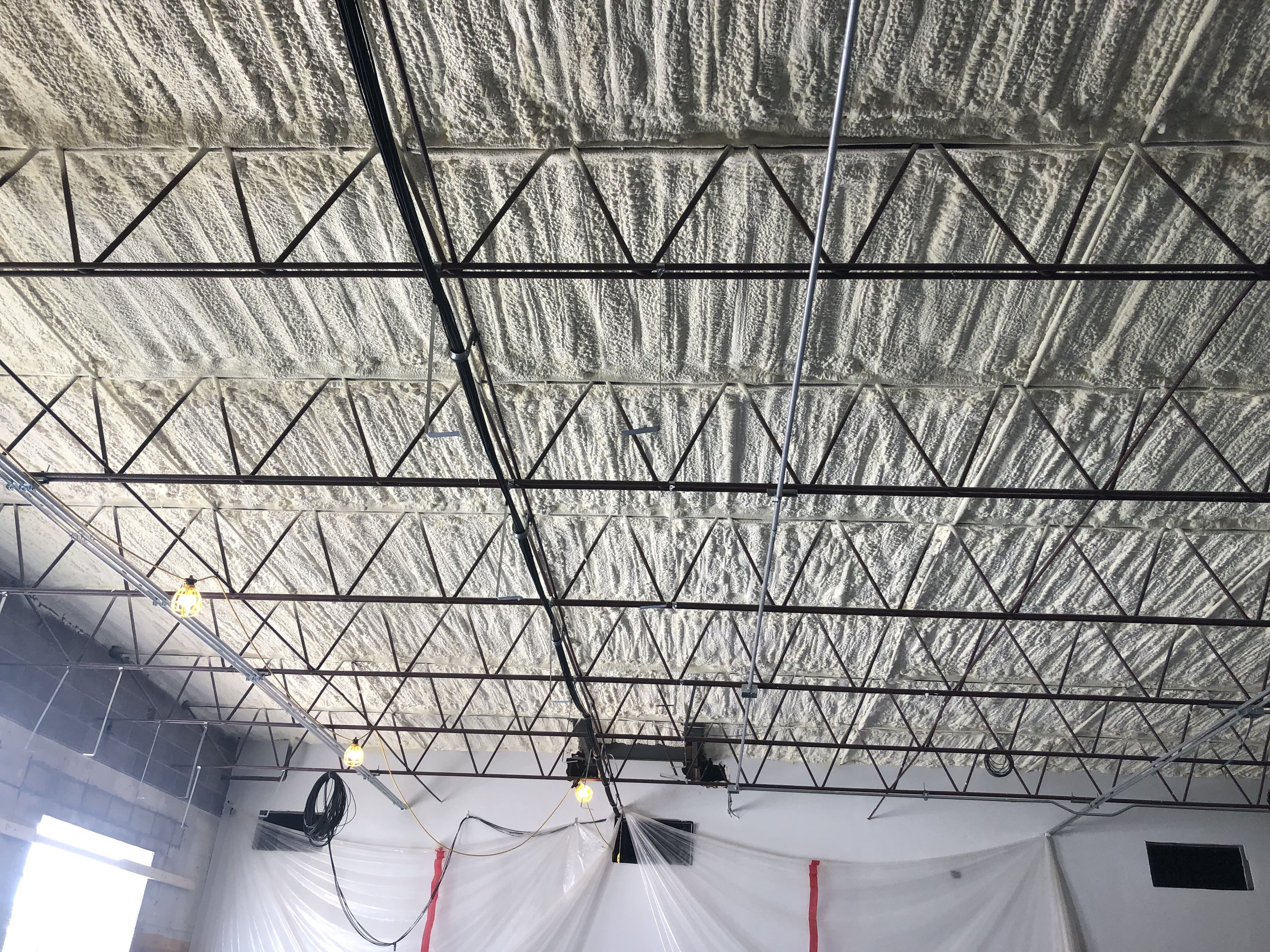
Our team evaluates the project specifications, building assembly, required R-value and moisture conditions before recommending a commercial spray foam system.
Commercial Buildings We Insulate
Complete Insulation provides spray foam installation for:
Office buildings
Warehouses
Distribution centers
Retail stores
Shopping centers
Restaurants
Hotels
Multifamily properties
Apartment buildings
Mixed-use developments
Medical and professional offices
Schools
Churches
Manufacturing facilities
Agricultural buildings
Metal buildings
Shops and storage facilities
Barndominiums
Tenant-improvement projects
We coordinate with general contractors, project managers and other trades to keep the insulation scope aligned with the construction schedule.
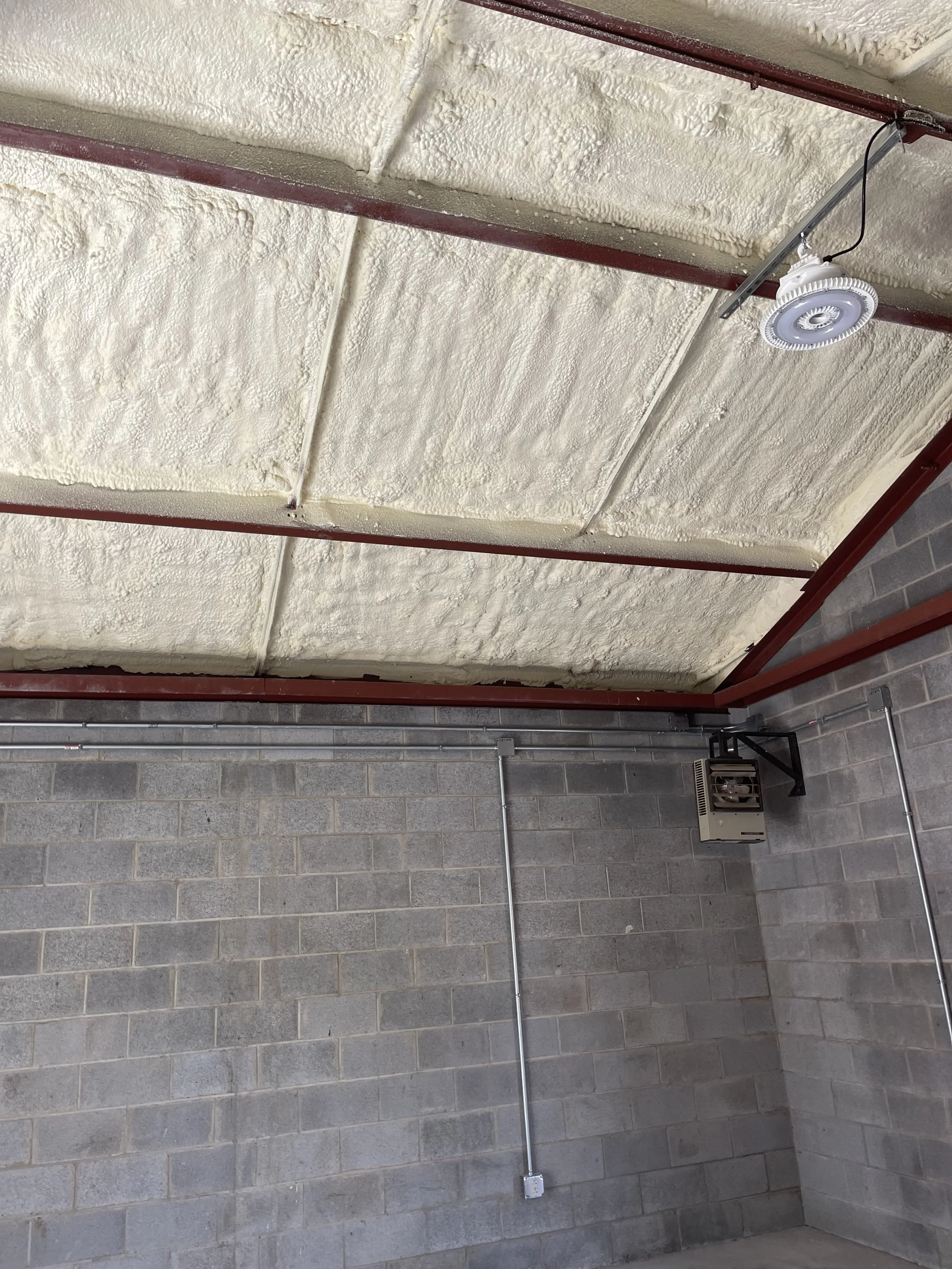
Benefits of Commercial Spray Foam Insulation
-
Building-Envelope Performance
Commercial buildings can lose conditioned air through gaps at roof-to-wall connections, penetrations, joints and transitions between materials. Spray foam expands into irregular areas and can create an air barrier at the specified thickness.
-
Reduced Heating & Cooling Demand
When uncontrolled outdoor air enters a building, HVAC equipment must condition additional air. A tighter, better-insulated envelope can reduce unnecessary heating and cooling loads. Actual savings depend on building size and use, operating hours, HVAC efficiency, existing insulation, air-leakage rates and more.
-
Continuous Coverage
Spray foam can conform to irregular framing, curved surfaces and penetrations that may be difficult to insulate with rigid or pre-cut materials.
-
High R-Value in Limited Space
Closed-cell foam generally provides a higher R-value per inch than open-cell foam. It may be useful in assemblies with limited depth or more demanding performance requirements.
-
Moisture-Control Support
Air leakage can move moisture into roof, wall and ceiling assemblies. A properly designed air barrier may help reduce moisture carried by uncontrolled airflow. Spray foam does not replace roof repairs, flashing, drainage, waterproofing or humidity control.
-
Condensation Control for Metal Buildings
Closed-cell spray foam may help reduce condensation potential on metal surfaces by limiting contact between humid indoor air and colder metal panels. The complete assembly, indoor humidity and ventilation requirements must still be considered.
-
Sound Absorption
Open-cell foam can help absorb airborne sound in certain interior or exterior assemblies. Complete acoustic performance depends on the entire wall, floor or ceiling system.
Open-Cell vs. Closed-Cell Spray Foam
-
Open-Cell Commercial Spray Foam
Open-cell spray foam is a lower-density, flexible material that expands significantly after application.
A Department of Energy technical guide describes open-cell foam as approximately one-half pound per cubic foot with a typical R-value around R-3.5 per inch. Product-specific values may differ.
Open-cell foam may be appropriate for:
Interior walls
Roofline assemblies
Office spaces
Multifamily buildings
Sound-control applications
Large framing cavities
Areas designed to allow inward drying
Commercial renovations
Potential benefits include:
Air-barrier performance at the specified thickness
Expansion into irregular cavities
Sound absorption
Lower material density
Potentially lower cost than closed-cell foam
Because open-cell foam is vapor-permeable, the project team must consider the wall or roof assembly’s complete moisture-control design.
-
Closed-Cell Commercial Spray Foam
Closed-cell spray foam has a denser, rigid structure. It offers a higher R-value per inch and greater resistance to moisture than open-cell foam.
The Department of Energy reports that typical closed-cell foam provides approximately R-6 per inch, depending on the product.
Closed-cell foam may be appropriate for:
Warehouses
Metal buildings
Manufacturing facilities
Roof and wall assemblies
Cold-storage support assemblies
Rim joists
Masonry walls
Below-grade walls in approved applications
Areas with limited cavity depth
Spaces requiring greater moisture resistance
Exterior commercial applications approved by the manufacturer
Potential advantages include:
Higher R-value per inch
Air-barrier performance
Vapor-retarder performance at specified thicknesses
Greater rigidity
Water resistance
Adhesion to compatible materials
Condensation-control support
Closed-cell foam has a higher material density and generally costs more than open-cell foam. Product selection should be based on project requirements rather than price alone.
-
Open-Cell vs. Closed-Cell Foam for Commercial Buildings
Open-cell spray foam may be considered when:
Large wall or roof cavities are available
Sound absorption is important
The assembly must remain more vapor-permeable
Greater foam expansion is beneficial
The project does not require the higher R-value per inch of closed-cell foam
Closed-cell spray foam may be considered when:
Higher R-value is needed in limited space
Greater water resistance is required
A more rigid insulation is preferred
The design calls for vapor-retarder performance
Foam will be applied to an approved metal, masonry or exterior surface
Some buildings may use different insulation materials in different assemblies. Complete Insulation also installs fiberglass, allowing us to help contractors compare options for each part of the project.
Commercial Spray Foam FAQs
Is spray foam suitable for commercial buildings?
Yes. Spray foam is used in offices, warehouses, metal buildings, retail spaces, multifamily properties and many other commercial structures.
Is open-cell or closed-cell foam better for a warehouse?
The correct product depends on the building assembly, required R-value, moisture conditions, fire requirements and budget. Closed-cell foam is often considered for metal buildings because of its higher R-value and moisture resistance.
Can spray foam reduce commercial energy costs?
It can reduce heat transfer and uncontrolled air leakage. Actual savings depend on the building, HVAC system, operating schedule and installation.
Can a business remain open during installation?
Possibly, but the application area must be isolated and unprotected occupants must remain outside the controlled work zone. Some projects require temporary or phased closure.
Does spray foam stop condensation in a metal building?
It can help reduce condensation by separating humid air from colder metal surfaces. Indoor humidity, ventilation, roof leaks and the complete building assembly must also be addressed.
Does spray foam require a thermal barrier?
Many applications require a thermal or ignition barrier. Requirements depend on the product, occupancy, accessibility and applicable building standards.
Can spray foam be used in multifamily construction?
Yes. Spray foam may be used in exterior walls, attics, roofline assemblies, rim joists and other parts of multifamily buildings when included in an approved assembly.
Does Complete Insulation work with general contractors?
Yes. We work with general contractors, developers, builders, property managers and commercial owners on new construction, renovations and retrofit projects.
Request a Commercial Spray Foam Quote
Complete Insulation provides commercial spray foam insulation throughout Murfreesboro, Rutherford County and Middle Tennessee.
Call 615-614-8800 or request a commercial spray foam estimate for your office, warehouse, metal building, multifamily property or new construction project.